
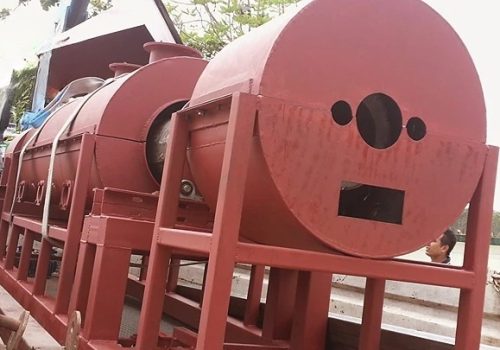


Rotary Kilns
Technical Specifications (Customizable)
| Kiln Type | Rotary cylinder |
| Length & Diameter | Customized as per capacity |
| Operating Temperature | Up to 1600°C (depending on material) |
| Drive System | Gear and motorized drive for controlled rotation |
| Refractory Lining | High-quality, heat-resistant bricks or castable lining |
Rotary Kilns are high-capacity cylindrical furnaces that rotate slowly around their axis to provide continuous thermal processing of materials.
Designed for high-temperature applications, rotary kilns are widely used in industries such as cement, metallurgy, lime, refractory, and chemical processing to achieve uniform heating, calcination, and chemical reactions.
Key Features
- Rotating Cylinder Design: Ensures even heat distribution and thorough material processing.
- High-Temperature Capability: Engineered to withstand extreme temperatures required for calcination, sintering, or roasting.
- Robust Construction: Heavy-duty steel shell and refractory lining provide durability and long service life.
- Customizable Length & Diameter: Designed to match specific industrial throughput and material handling requirements.
- Efficient Fuel or Electric Heating: Supports multiple heating methods including coal, gas, oil, or electricity.
Applications
- Cement and lime production
- Metallurgical processes such as ore roasting and sintering
- Refractory material manufacturing
- Chemical processing and calcination operations
- Environmental applications such as waste incineration
Benefits of Rotary Kilns
- Continuous, high-volume processing for large-scale production
- Uniform heat distribution for consistent product quality
- Energy-efficient design reduces operational costs
- Suitable for a wide range of materials and chemical reactions
- Long-term durability with minimal maintenance
Why Choose Our Rotary Kilns?
Our Rotary Kilns are engineered for precision, efficiency, and long-term reliability in demanding industrial environments.
Designed for seamless integration with material handling systems and downstream processing equipment, they deliver consistent thermal processing, improved productivity, and reduced operational costs.
.